Introduction
A dual scientific and institutional breakthrough for Belgian medical acupuncture
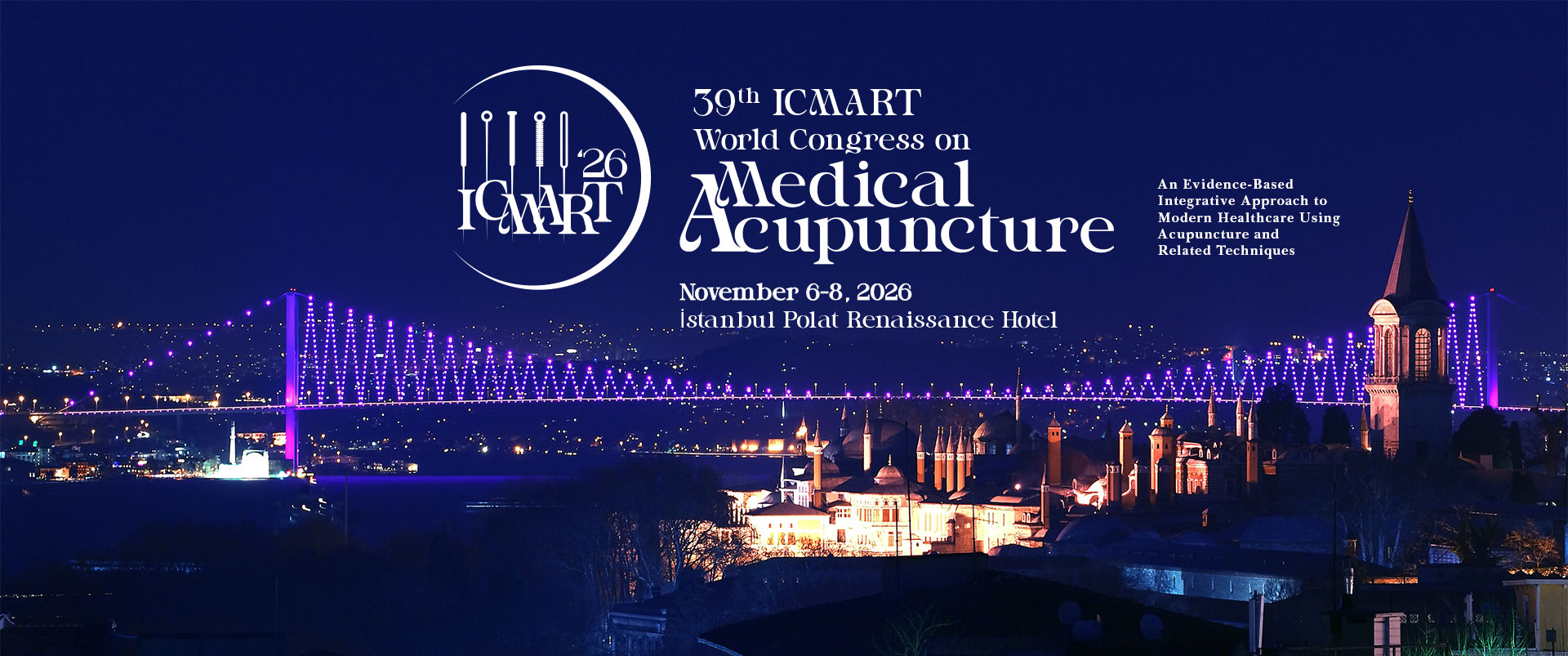
From November 6 to 8, 2026, the 39th World Congress of the International Council of Medical Acupuncture and Related Techniques (ICMART) was held in Istanbul, bringing together over 500 physicians and scientific participants from more than 30 countries. The Belgian Association of Medical Acupuncturists (ABMA–BVAA) was represented by its president, Dr. Olivier Cuignet, who participated both as a scientific speaker and as an advocate for the role of medical acupuncture within the Belgian healthcare system.
Organized by four Turkish medical acupuncture associations, the ICMART 2026 congress brought together physicians, researchers, educators, and representatives of national associations from across the globe.
The lectures and scientific sessions addressed recent progress in understanding the neurophysiological mechanisms of acupuncture, its clinical applications, neuromodulation techniques, and prospects for its integration into contemporary medicine.
Beyond the scientific presentations, this congress provided a unique opportunity for leaders of ICMART member associations to meet and discuss issues related to training, professional recognition, research, and patient safety.
The ABMA's participation reflected this dual scientific and institutional focus.
Dr. Olivier Cuignet, an anesthesiologist and pain specialist, presented a scientific paper on persistent neuropathic pain associated with long COVID and the therapeutic potential of segmental electroacupuncture.
This presentation was based on recent research regarding the potential role of autoimmune mechanisms in certain types of long COVID neuropathic pain.
Experimental work, notably conducted at the University of Namur and published in 2026, has shown that immunoglobulins from patients with long COVID-related neuropathic pain could transfer pain hypersensitivity to animals. These observations suggest a specific involvement of the dorsal root ganglia (Dorsal Root Ganglia or DRG), which are essential structures in the transmission of sensory and nociceptive information.
These ganglia could therefore represent a relevant pathophysiological target for certain forms of persistent neuropathic pain.
On this basis, Dr. Cuignet presented the potential value of segmental neuromodulation via electroacupuncture, specifically using Jiaji paravertebral points and the Bladder meridian's dorsal points, which are anatomically related to the affected spinal segments.
A detailed clinical observation, supplemented by initial results from a series of ten patients, illustrated the improvements observed in neuropathic pain, allodynia, and certain associated musculoskeletal symptoms.
This approach remains exploratory and requires controlled prospective studies to confirm its efficacy, define its indications, and better understand its mechanisms of action.
The presentation was very well received, reflecting the participants' interest in this approach, which combines neuro-immunological research, pain pathophysiology, and medical acupuncture.
Dr. Cuignet is currently continuing his clinical observations, with plans to present further results at the upcoming Society for Acupuncture Research (SAR) congress, scheduled for Baltimore in April 2027.
In addition to his scientific presentation, Dr. Cuignet, in his capacity as president of the ABMA, addressed the ICMART General Assembly to inform representatives of national associations about the concerning situation regarding medical acupuncture in Belgium.
The repeal of the Colla Law in November 2025 has significantly altered the legal framework that had been established for non-conventional practices.
For the ABMA, this development raises several essential questions, particularly regarding the recognition of medical acupuncture, practitioner qualifications, and patient safety.
The association believes that the medical practice of acupuncture must be based on appropriate training, a rigorous understanding of indications and contraindications, and clearly defined requirements for quality and patient care safety.
According to the ABMA, the lack of a specific and sufficiently clear regulatory framework risks undermining these safeguards and making it more difficult for patients to identify practitioners with adequate training.
Dr. Cuignet also outlined the ABMA's concerns regarding statements made by the Federal Minister of Health, Frank Vandenbroucke, questioning whether there is sufficient scientific evidence to support acupuncture.
The ABMA disputes this general assessment, which it considers insufficiently nuanced given the numerous clinical and experimental studies available, particularly for certain chronic pain conditions.
It reiterates that the scientific evaluation of acupuncture must be based on a rigorous analysis of data, indication by indication, while taking into account the techniques used and their clinical outcomes.
This approach is part of the ongoing efforts by Belgian acupuncture associations to gain recognition for the need for objective scientific evaluation, particularly in their dealings with the Belgian Health Care Knowledge Centre (KCE).
The intervention by the ABMA president sparked interest among several foreign representatives.
The discussions revealed that other countries, including Turkey, Spain, and Australia, are also facing, in various forms, difficulties regarding the institutional recognition of acupuncture, its integration into healthcare systems, or the consideration of its scientific foundations.
However, national situations are not identical. For instance, in Turkey, acupuncture benefits from an official medical certification system, but its place in the organization of care and its institutional development remain subjects of debate.
These exchanges helped place the Belgian challenges within a broader international context. They also highlighted the value of sharing experiences and strategies developed by national associations facing comparable issues.
The concerns expressed by the ABMA were received with attention and a constructive spirit by members of the ICMART international Board of Directors.
The discussions focused in particular on the role this organization could play in providing more concrete support to its member associations when they face recognition difficulties or unfavorable regulatory decisions.
Members of the ICMART Board expressed their willingness to provide the ABMA with advice, shared experience, and, if necessary, institutional support.
This openness is particularly significant. As an international organization bringing together medical acupuncture associations, ICMART possesses a network of contacts and experience that can usefully contribute to efforts undertaken at the national level.
At this stage, this does not constitute an official commitment by ICMART to intervene with the Belgian authorities, but rather a constructive first step toward strengthened international cooperation.
Following these discussions, an initial practical initiative was proposed: organizing a videoconference bringing together representatives from the ABMA, members of the ICMART Board, and leaders of foreign associations that have previously faced similar challenges.
This meeting aims to:
This videoconference would serve as a first step before any more formal institutional action. It could also provide useful input for the initiatives already underway by the ABMA in collaboration with other Belgian acupuncture associations.
The ABMA's participation in the 2026 ICMART World Congress in Istanbul was positive on two levels.
Scientifically, it provided an opportunity to present to the international community an original approach to segmental neuromodulation for neuropathic pain in long COVID, based on recent advances in neuro-immunological research.
Institutionally, it helped raise awareness of the concerns of Belgian medical acupuncture, sensitized representatives of foreign associations to the consequences of the repeal of the Colla Law, and opened the door to concrete cooperation with ICMART.
The favorable reception of both presentations and the willingness expressed by Board members serve as encouragement to continue the efforts already begun.
The next step will be to translate these discussions into action through an initial international videoconference to identify the most appropriate forms of support and collaboration.
The congress has thus strengthened the scientific visibility of Belgian medical acupuncture while opening new avenues for international solidarity in defending high-quality, scientifically evaluated medical acupuncture that respects patient safety.
Dr. Olivier Cuignet
President of the Belgian Association of Medical Acupuncturists (ABMA–BVAA)
November 2026